
MOVEMENT 6 min read
Strength, mobility and body awareness are often sold as separate products. Pilates treats them as one practice. You load a pattern, you travel through a useful range, and you notice what your body is doing while you do it.
That combination is why Reformer rooms can feel different from both a stretch class and a noisy weights floor. The hour is still training. It is training with attention.
Quick answer
Reformer Pilates trains strength through spring resistance, mobility through organised range, and body awareness through cueing and slower tempos. At J Pilates those qualities sit inside the same 50–60 minute session rather than in three unrelated classes.
How these elements work together
If you only stretch, you may gain range you cannot control. If you only load, you may get stronger in a cramped pattern. Pilates tries to connect the two: move as far as you can organise, then add spring tension that you can still steer.
Awareness is the feedback loop. Without it, you will repeat the same compensation. With it, a small change in rib or pelvis position can change the entire exercise.
Strength
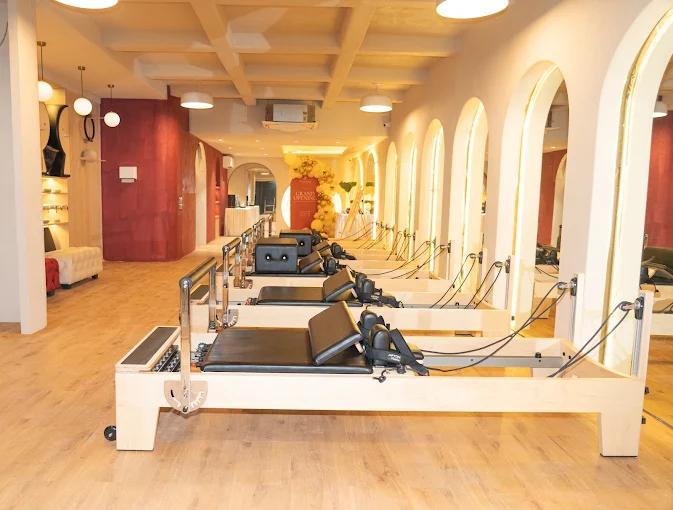
Springs are resistance. Pressing the footbar, pulling straps and holding the carriage still are all strength tasks. The difference is that the path is usually longer and more precise than a single gym machine isolation.
You may feel work in the centre, hips, back and shoulders in one sequence. That is normal. It is not a claim that Pilates replaces every other form of strength training for every goal.
Mobility
Mobility here means usable range — joints moving while you still have a strategy. The Reformer can support part of your weight so you can explore a range that might feel unavailable on the floor.
Instructors will still limit range if a position looks unorganised. More motion is not automatically better.
Body awareness
Awareness is knowing where you are. Clients often describe standing taller or noticing a shoulder habit at a desk. Those are examples, not guaranteed outcomes for every person.
InBody assessment is available if you like composition data alongside how you feel. It is optional, not a requirement for belonging in the room.
Why movement quality matters at J Pilates
The brand language is intentional, controlled and purposeful movement, taught with professional instruction and personalised attention. You can read that vision on About J Pilates and in the founder story.
Quality is not snobbery. It is how a boutique Reformer studio stays distinct from a class that only chases sweat.
Common questions
Will Pilates make me bulky?
Reformer work builds strength through control. It is not bodybuilding. How a body changes depends on many factors this page will not pretend to predict.
Can I combine this with other training?
Yes. Many people keep walking, running or other studio work. Tell the instructor what else you do so the hour can complement rather than compete on the same day.
Is this physiotherapy?
No. Physiotherapy is a separate listed service. Pilates is skilled movement training. Follow medical advice when you have a diagnosis or injury.
Practical guidance
Each J Pilates session lasts approximately 50–60 minutes. Wear comfortable activewear that allows free movement. Sessions can be rescheduled with at least 24-hour notice.
Start with Reformer Pilates. Add private coaching if you want the strength and mobility work more closely tailored. Book through the J Pilates online platform. The same booking path is used for Sanpada and Ghansoli; choose the studio that fits your commute.
What “quality” means without turning it into a slogan
Movement quality is easy to say and easy to fake on social media. In a Reformer room it is slower to fake. The carriage either travels true or it does not. Your breathing either stays with the work or it does not.
Strength here is not a leaderboard. It is the ability to press, pull and hold with springs while keeping the rest of the body from helping in the wrong places. Mobility is not a circus split. It is range you can still steer. Awareness is noticing the difference.
J Pilates puts those three together because the founder’s published vision is intentional movement, not a catalogue of isolated promises. You can read the editorial on Jyoti Singh. You cannot outsource the hour to a biography.
Individual results vary. Some people notice posture first. Some notice that a shoulder habit is louder than they thought. Some notice they are simply stronger on the footbar. None of that is guaranteed in a week, which is why the eight-session planning note exists.
If you want clinical care, that is physiotherapy — a listed service, not a rebrand of the Reformer class. If you want composition numbers, that is InBody. Keep the categories honest and the training stays useful.
The next practical step is still a booking. Strength, mobility and awareness are not downloaded. They are repeated in Sanpada or Ghansoli until they feel less foreign.
FAQ
Does Pilates build strength?
Yes, when you work with resistance and control. Reformer springs provide load. The strength is often more specific than a generic gym circuit.
Is Pilates only stretching?
No. Mobility is part of the work, but so is strength and coordination. Stretching without organisation is not the whole method.